
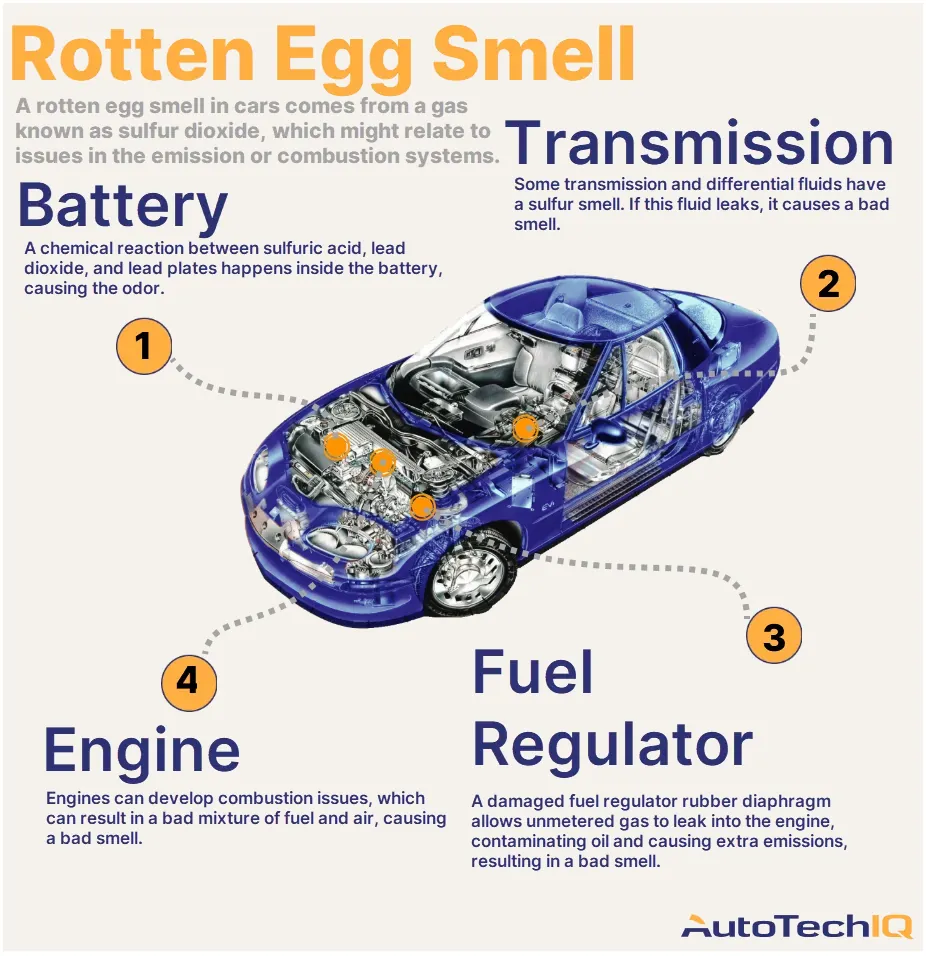
A sulfur smell from your car usually means one of four things: a failing catalytic converter, old transmission fluid, a leaking battery, or a fuel system problem. The most common cause of car smells like rotten eggs is a catalytic converter that can no longer turn hydrogen sulfide into odorless sulfur dioxide. Each source smells similar, but they need different fixes, so finding the right one matters more than covering up the odor.
Why does my car smell like rotten eggs?

The table below ranks the likely causes from most common to least common, so you can see where to look first.
| Cause | Best for spotting |
|---|---|
| Failing catalytic converter | Smell worsens under hard acceleration |
| Old transmission fluid | Smell appears after shifting gears |
| Leaking car battery | Smell is strongest near the engine bay |
| Rich fuel mixture | Smell comes with black exhaust smoke |
| Cause | Best for spotting | Example |
|---|---|---|
| Failing catalytic converter | Smell worsens under hard acceleration | 2015 Toyota Camry with a clogged converter |
| Old transmission fluid | Smell appears after shifting gears | 2018 Honda Civic with burnt fluid |
| Leaking car battery | Smell is strongest near the engine bay | Corroded terminals on a 2012 Ford Focus |
| Rich fuel mixture | Smell comes with black exhaust smoke | Faulty fuel pressure regulator |
Failing catalytic converter
This part sits in your exhaust system, converting toxic pollutants into inert gases. It’s standard on every gasoline vehicle built after 1975. You should suspect this component first when a sharp, sulfurous odor intensifies as you accelerate.
The converter transforms hydrogen sulfide into odorless sulfur dioxide. When the internal honeycomb structure melts or clogs, this chemical reaction stalls. You’ll notice a distinct rotten egg smell trailing your vehicle.
Most drivers mistake this for a fuel leak or a battery issue. If you ignore the smell, the resulting backpressure forces exhaust gases back toward the engine. This leads to misfires, a permanent check engine light, and a 10% drop in fuel economy.
If your engine idles smoothly but loses power under load, the converter is likely restricted. If the car struggles to start or stalls at traffic lights, the issue is usually a faulty fuel pump instead. Replacing a failed converter restores both your exhaust chemistry and your vehicle’s throttle response.
Old transmission fluid
Transmission fluid lubricates and cools the gears inside your transmission. It suits automatic and manual vehicles, and it becomes the likely cause when the smell appears shortly after you shift gears or drive in stop-and-go traffic.
Old fluid breaks down and releases sulfur compounds when it overheats. This chemical degradation creates a distinct, acrid scent similar to burnt toast. If you notice this odor, check the fluid color immediately. Healthy fluid is translucent red, while burnt fluid turns dark brown or black and loses its viscosity.
A fluid change is much more affordable than a transmission rebuild. Neglecting this maintenance leads to internal clutch slippage and permanent heat damage to the valve body. If your gears slip or shift with a noticeable delay, replace the fluid before metal shavings contaminate the system. Once debris enters the internal seals, a simple fluid swap will no longer solve the underlying mechanical wear.
Leaking car battery

A car battery holds lead plates submerged in sulfuric acid. It suits every vehicle with a 12-volt starting battery, and it takes over as the prime suspect when the smell is strongest right after you open the hood.
Overcharging or internal damage can vent hydrogen sulfide gas. This gas smells like rotten eggs and collects around the battery tray. Corrosion on the terminals often appears at the same time. If you see a white, crusty buildup on the posts, the casing has likely already failed.
Replacing the battery removes the gas source and protects nearby wiring from acid erosion. Don’t attempt to top off the electrolyte levels in a sealed maintenance-free unit. If the battery case is bulging or hot to the touch, disconnect the negative terminal immediately to prevent a fire.
A strong smell near the front of the engine bay combined with corroded battery terminals confirms the battery is the culprit.
Rich fuel mixture
This happens when the engine burns more fuel than air can fully consume. It suits fuel-injected gasoline cars, and it becomes the likely cause when the egg smell arrives with black smoke from the tailpipe.
Unburned fuel passes through the exhaust and creates sulfur odors. If you notice a sudden drop in your fuel economy—typically a loss of two to four miles per gallon—check your spark plugs. Sooty, black deposits on the plug tips confirm the mixture is too rich.
A faulty fuel pressure regulator or leaking injector often causes it. If the engine idles roughly while cold but smooths out as it warms, look toward the fuel pressure regulator. If the rough idle persists regardless of temperature, a leaking fuel injector is the more probable culprit.
Continuing to drive with a rich mixture can overheat the catalytic converter. This mistake often results in a melted internal substrate, turning a minor sensor repair into a costly replacement.
Choosing the right cause
Decide by matching the smell to when it happens and where it’s strongest. If the odor gets worse under hard acceleration and the check engine light is on, the catalytic converter is the likely culprit.
If the smell appears after shifting gears, old transmission fluid points the way. Check the dipstick; if the fluid is brown or smells like burnt toast, it needs an immediate change.
If the odor is strongest under the hood near the battery, check for corrosion and venting first. A rotten egg smell here often signals an overcharging alternator boiling the electrolyte.
If black exhaust smoke comes with the smell, a rich fuel mixture is the best fit. These causes can overlap. A rich mixture frequently clogs the catalytic converter, so fixing one without the other may not end the smell. If you replace the converter but ignore the fuel injectors, the new part will likely fail prematurely.
Related guides
Frequently asked questions
Can I keep driving if my car smells like rotten eggs?
You can drive a short distance to a repair shop, but not for daily use. A failing converter or a leaking battery can create a fire risk or leave you stranded.
Why does the smell get worse when I accelerate?
Hard acceleration pushes more exhaust through the system, so a converter that can’t process sulfur gases releases more odor under load.
Is a rotten egg smell dangerous?
Hydrogen sulfide is toxic in high concentrations, and a leaking battery vents flammable gas. Treat any strong sulfur odor as a reason to get the car checked.
What happens if I ignore it?
A clogged converter can overheat and damage the engine, while old transmission fluid can lead to a full transmission failure.
Does it matter where the smell comes from?
Yes. Under the hood points to the battery; from the tailpipe points to the converter or fuel mixture; inside the cabin may mean an exhaust leak.
How long does a catalytic converter last?
It often lasts 100,000 miles or more, but poor fuel quality, oil burning, or engine misfires can kill it much sooner.
What should I do first?
Open the hood and check where the odor is strongest, then book an inspection with a qualified mechanic before the problem spreads.
What to do next
Start by noting when the smell appears and where it’s strongest, then book an inspection with a qualified mechanic. Expect the shop to pressure-test the exhaust, scan for engine codes, and check the battery and transmission fluid. If the odor is strong inside the cabin or you see smoke under the hood, stop driving and call for a tow instead.
A strong sulfur odor in your car is a warning, not a nuisance. The four likely causes — a failing catalytic converter, old transmission fluid, a leaking battery, or a rich fuel mixture — each need a different repair, and matching the smell to its timing and location tells you which one to pursue first.
You can safely check where the odor is strongest and look for visible corrosion or smoke, but replacing a converter or diagnosing a fuel system belongs to a qualified mechanic. Get the car inspected before the smell turns into a breakdown or a safety risk.
EPA guidance on vehicle emissions
Conclusion
Don’t ignore this warning sign, as it won’t go away on its own. If you aren’t comfortable inspecting these parts yourself, it’s best to schedule a diagnostic appointment with a trusted mechanic. They’ll pinpoint the exact source of the odor so you can get back to driving without that unpleasant scent.