
Have you ever wondered why your phone call sounds clear, but the old radio sometimes crackles? The answer lies in the difference between digital and analog signals.
Understanding these two types of signals can help you make smarter choices about your devices and technology. You’ll discover what sets digital signals apart from analog ones, how each affects the quality of your audio and video, and why it matters in your everyday life.
Keep reading to unlock the secrets behind the signals that power your world.

Credit: controlbyte.tech
Signal Basics
Signals carry information from one place to another. They are the foundation of communication systems. Understanding the basics of signals helps explain how devices like phones and radios work.
Signals come in two main types: analog and digital. Each type has unique features and uses.
What Is An Analog Signal
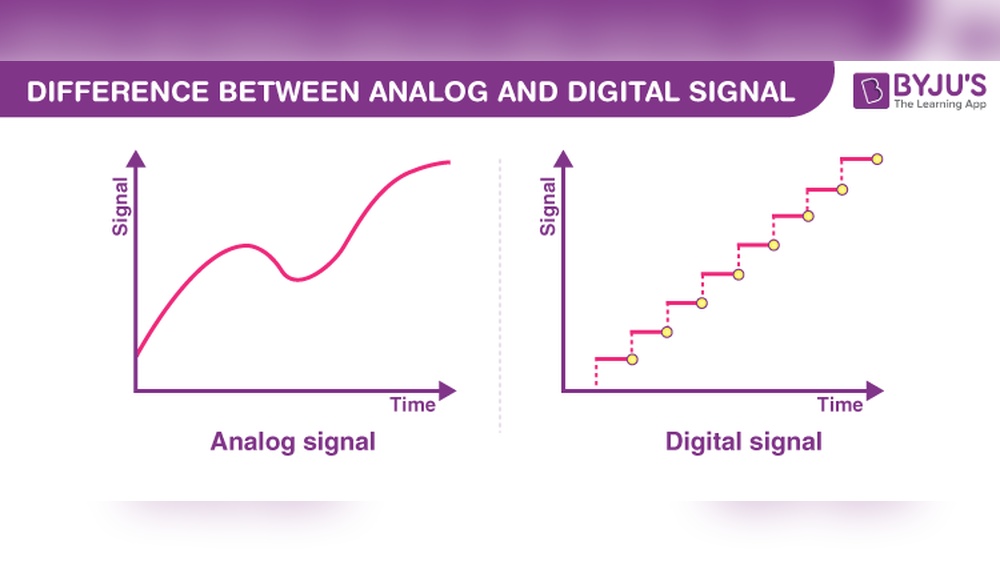
An analog signal is continuous. It changes smoothly over time. It can take any value within a range. Examples include sound waves and light intensity. These signals represent real-world information naturally.
Analog signals can be seen on graphs as smooth curves. They vary without sudden jumps. Devices like old radios and vinyl records use analog signals.
What Is A Digital Signal
A digital signal has discrete values. It uses numbers, usually zeros and ones. These values represent information in steps, not continuously. Digital signals are easy to store and process.
Computers and modern phones use digital signals. They convert real-world data into digital form. This helps in error checking and improving signal quality.
Waveform Characteristics
Waveform characteristics define how signals carry information. They help distinguish digital signals from analog ones. Understanding these traits is key to grasping their uses and behaviors. Two main aspects stand out: the type of signal and its amplitude and frequency patterns.
Continuous Vs Discrete Signals
Analog signals are continuous. They change smoothly over time, with no breaks. This means they can have any value at any moment. Digital signals are discrete. They have specific values, usually just two: 0 and 1. These values switch sharply from one to the other. This makes digital signals easier to store and process. Continuous signals show natural variations. Discrete signals show step-like changes.
Amplitude And Frequency Patterns
Amplitude is the signal’s strength or height. Analog signals vary in amplitude smoothly and often change in complex ways. Digital signals have fixed amplitude levels, typically high or low. Frequency refers to how often the signal repeats. Analog waves can have many frequencies mixed. Digital signals use a constant frequency or clock signal. The patterns in amplitude and frequency affect signal quality and clarity. Analog signals can degrade with noise. Digital signals resist noise better due to clear amplitude steps.
Signal Transmission
Signal transmission is the process of sending information from one point to another. It is essential in communication systems like phones, radios, and computers. Both digital and analog signals carry data, but they do it differently. Understanding how these signals transmit helps to see their strengths and weaknesses.
Noise And Interference Effects
Noise is unwanted disturbance that affects signal quality. Analog signals are more vulnerable to noise. The signal can become weak or distorted over long distances. Digital signals use binary code, which resists noise better. Even if some bits change, error-checking can fix them. This makes digital signals clearer and more reliable.
Signal Range And Strength
Analog signals lose strength as they travel. This causes fading and reduces the signal range. Amplifiers can boost the analog signal but may also increase noise. Digital signals keep their strength better over distances. Repeaters regenerate the signal without adding noise. This allows digital signals to travel farther and stay strong.

Credit: www.youtube.com
Data Representation
Data representation is the way information is shown in signals. It defines how data is encoded and transmitted. Understanding this helps grasp the difference between analog and digital signals.
Analog signals represent data with continuous waves. These waves change smoothly over time, matching the original information. Digital signals use discrete values. They represent data as a series of bits, like 0s and 1s.
Analog Encoding Methods
Analog encoding changes data into continuous signals. It uses variations in amplitude, frequency, or phase. Amplitude modulation (AM) changes the wave’s height. Frequency modulation (FM) changes the wave’s speed. Phase modulation (PM) shifts the wave’s starting point. These methods make the signal carry information smoothly.
These analog methods are simple and work well with natural signals. They can be affected by noise, causing distortion. Noise reduces the signal quality during transmission.
Digital Encoding Techniques
Digital encoding turns data into binary numbers. It uses patterns of 0s and 1s to show information. Common methods include Non-Return to Zero (NRZ) and Manchester encoding. NRZ keeps voltage high or low for bits. Manchester combines clock and data signals into one wave.
Digital encoding resists noise better than analog. It allows error detection and correction. This keeps data clearer over long distances. Digital signals are easier to store and process with computers.
Advantages And Disadvantages
Understanding the advantages and disadvantages of digital and analog signals helps in choosing the right technology. Each type has unique strengths and weaknesses. Knowing these can guide better decisions in communication and electronics.
Benefits Of Digital Signals
Digital signals carry data as binary code. This makes them less sensitive to noise and interference. As a result, they provide clearer and more reliable communication.
They allow easy data storage and transfer. Digital signals can be compressed to save space and bandwidth. This leads to faster and more efficient communication systems.
Error detection and correction are possible with digital signals. This improves the accuracy of data transmission. Digital technology also supports encryption for secure communication.
Limitations Of Analog Signals
Analog signals represent data in continuous waves. They are more prone to distortion and noise. This leads to lower signal quality over long distances.
Analog signals cannot be easily compressed. This makes data storage and transfer less efficient. Signal degradation happens every time the signal is copied or transmitted.
Analog systems lack advanced error correction. This increases the chance of data loss or corruption. They are also harder to encrypt and secure compared to digital signals.

Credit: crossroadenergy.com
Applications In Technology
Digital and analog signals play a big role in many technologies today. Each type of signal fits different needs. Understanding their applications helps us see how devices work.
Both signals transmit information, but their methods differ. This difference affects where and how they are used in technology.
Use In Communication Systems
Digital signals are common in modern communication systems. They carry data in binary form, using ones and zeros. This method makes communication clear and reliable.
Analog signals transmit information as continuous waves. They are often used in traditional radio and television broadcasts. Analog signals can vary smoothly but are more prone to noise.
Many mobile phones and internet systems use digital signals. These signals reduce errors and improve security. Analog signals still work in some older or simple systems.
Role In Audio And Video Devices
Audio and video devices use both signal types. Digital signals help in devices like CDs, DVDs, and streaming services. They give high quality and easy editing.
Analog signals are used in older audio devices such as vinyl records and cassette tapes. They provide a natural sound but can degrade over time.
Modern devices often convert analog signals to digital for better processing. This conversion allows for clearer sound and picture quality.
Conversion Between Signals
Signals must often change forms to work with different devices. Conversion between analog and digital signals helps this process. This change lets devices send, store, or display data properly. Each type of conversion has its own methods and tools.
Analog-to-digital Conversion
Analog-to-digital conversion changes continuous signals into digital data. This process uses a device called an ADC (Analog-to-Digital Converter). The ADC measures the analog signal at regular time steps. Each measurement is then turned into a number.
The result is a digital signal made of many numbers. This digital signal can be stored on computers or sent over networks. This method is common in music, video, and sensor data.
Digital-to-analog Conversion
Digital-to-analog conversion changes digital data back into a continuous signal. A DAC (Digital-to-Analog Converter) performs this change. It takes the numbers and creates a smooth signal that matches the original.
This process is important for devices like speakers and old TVs. It allows digital information to become sound or images that humans can perceive. The quality depends on how well the DAC works.
Frequently Asked Questions
What Is The Main Difference Between Digital And Analog Signals?
Digital signals use discrete values, while analog signals use continuous waves. Digital signals are easier to store and process.
Which Signal Type Is Better For Long-distance Communication?
Digital signals are better for long-distance because they resist noise and interference. Analog signals lose quality over long distances.
How Do Digital Signals Represent Information?
Digital signals represent information using binary code, with zeros and ones. This makes data clear and easy to read.
Can Analog Signals Be Converted To Digital Signals?
Yes, analog signals can be converted to digital using an ADC (Analog-to-Digital Converter). This process helps in digital processing.
Why Are Digital Signals Preferred In Modern Electronics?
Digital signals offer higher accuracy and reliability. They work well with computers and modern devices.
Conclusion
Digital and analog signals both play important roles in technology. Digital signals use clear, separate values like 0s and 1s. Analog signals change smoothly and can show more detail. Each type has strengths and fits different needs. Choosing the right signal depends on your device and purpose.
Understanding these basics helps you make better tech choices. Simple but key differences make all the difference.