Have you ever wondered how businesses predict the future of their products or processes without risking time and money? That’s where digital twins and simulations come into play.
But what exactly sets them apart, and which one is right for your needs? Understanding the key differences can save you from costly mistakes and help you make smarter decisions. Keep reading to discover how digital twins and simulations work, why they matter, and how you can choose the best tool to boost your success.

Credit: www.simularge.com
Digital Twin Basics
Digital twins are changing how we understand and manage systems. They provide a real-time, virtual copy of a physical object or process. This helps businesses make smarter decisions and improve performance.
Understanding the basics of digital twins helps you see their value. Below, we explain what a digital twin is, its core parts, and where it is commonly used.
What Is A Digital Twin
A digital twin is a virtual model of a real-world object or system. It uses data from sensors to mirror the physical object’s condition and behavior. This model updates in real time, showing changes as they happen.
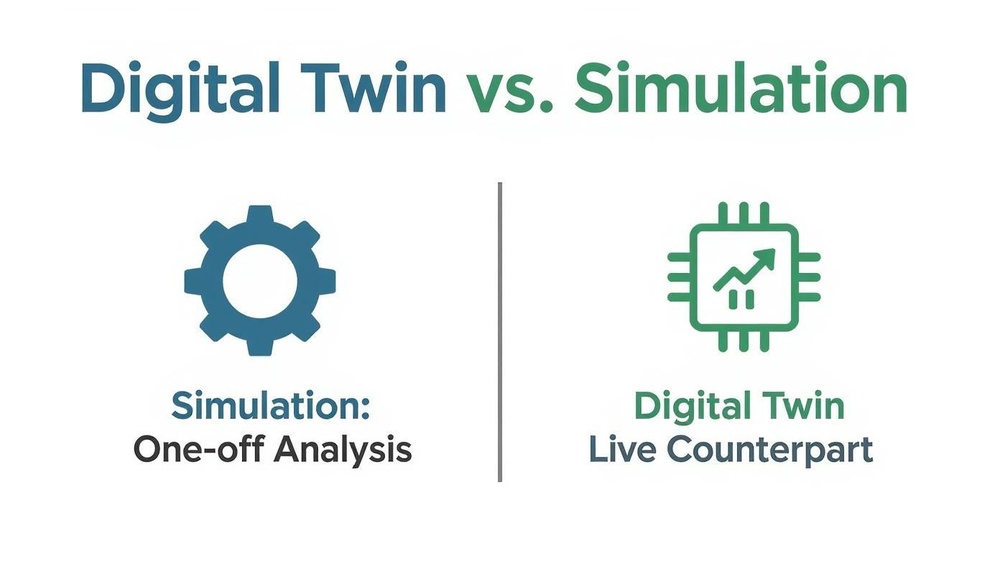
Unlike simple simulations, digital twins connect directly to their physical counterparts. This connection allows continuous monitoring and analysis. The digital twin reflects any changes or issues instantly.
Core Components
Digital twins have three main parts: the physical object, the digital model, and data connections. Sensors on the physical object collect data like temperature, speed, or pressure. This data flows to the digital model.
The digital model processes this data to mimic the real object’s state. Software tools analyze the data and predict future outcomes. Together, these parts create a live, interactive copy of the object.
Common Applications
Digital twins are used in many industries. In manufacturing, they monitor machines to prevent breakdowns. In smart cities, they help manage traffic and energy use.
Healthcare uses digital twins to simulate patient conditions for better treatment. Even in aerospace, digital twins track aircraft systems for safety and maintenance. These examples show how versatile digital twins can be.
Simulation Essentials
Simulation is a powerful tool used to imitate real-world processes. It helps people study how systems behave without physical trials. Simulations save time and reduce costs by predicting outcomes in a virtual space.
This section covers the basics of simulation. You will learn what simulation means, the different types, and common uses. Understanding these points will clarify how simulation works and why it matters.
What Is Simulation
Simulation is a method to create a digital model of a real system. It mimics the behavior and responses of that system over time. This allows testing and analysis without interacting with the physical object.
It uses mathematical models and algorithms to represent real processes. Users can change variables and observe effects quickly. Simulations help predict results and support decision-making.
Types Of Simulations
There are several types of simulations based on purpose and method. Discrete event simulation focuses on events happening at specific times. Continuous simulation models systems changing over time smoothly.
Agent-based simulation uses individual entities to study complex interactions. Monte Carlo simulation relies on random sampling to understand uncertainty. Each type serves different needs and scenarios.
Typical Use Cases
Simulations are common in many fields. Engineers test product designs before building physical prototypes. Healthcare professionals simulate surgeries to improve techniques and outcomes.
Businesses use simulation for supply chain management and risk assessment. Urban planners model traffic flow and city growth. Simulations also train pilots and operators safely.
Data Integration
Data integration plays a crucial role in both digital twins and simulations. It defines how these tools use information to create models and predictions. Understanding the differences in data handling helps to choose the right approach for a project.
Real-time Data In Digital Twins
Digital twins rely heavily on real-time data. Sensors and devices feed live information into the digital model. This allows the twin to mirror the current state of the physical object or system. Changes happen instantly, making the digital twin a dynamic and accurate representation. This real-time data helps with monitoring, predicting, and optimizing performance continuously.
Static Vs Dynamic Data In Simulations
Simulations mostly use static or pre-set data. The inputs are fixed before the simulation runs. This data does not update during the process. The simulation shows possible outcomes based on those initial conditions. It lacks the continuous feedback loop seen in digital twins. Simulations are useful for testing theories or designs without real-time updates.

Credit: innovateenergynow.com
Interactivity And Feedback
Interactivity and feedback play a key role in both digital twins and simulations. They allow users to engage with models actively. Users can make changes and see how systems respond. This interaction helps improve understanding and decision-making.
Both digital twins and simulations provide feedback, but they do so differently. Digital twins offer real-time data and updates from physical systems. Simulations often run scenarios that predict future outcomes based on set inputs.
Continuous Feedback Loops
Digital twins use continuous feedback loops to stay accurate. They collect data from sensors on real objects constantly. This data updates the digital model instantly. The model reflects the current state of the physical system.
Feedback helps detect problems early. It allows quick adjustments to improve performance. Continuous loops keep the digital twin synchronized with the real world. This makes it a powerful tool for monitoring and control.
Scenario Testing In Simulations
Simulations let users test many what-if scenarios. They change variables and see possible results. This helps predict how systems behave under different conditions. Scenario testing is useful for planning and risk assessment.
Simulations do not always use real-time data. They focus on exploring future possibilities. This makes them excellent for training and design experiments. Users learn how changes might impact the system before applying them.
Accuracy And Complexity
Accuracy and complexity are key factors in comparing digital twins and simulations. Both aim to replicate real-world systems but differ in detail and depth. Understanding these differences helps choose the right tool for specific needs.
Model Fidelity In Digital Twins
Digital twins offer high model fidelity. They create a near-exact copy of the physical asset. This includes real-time data and precise behavior patterns. The model updates continuously with live information. This accuracy helps detect issues early and optimize performance. Digital twins handle complex systems with many variables. This complexity allows detailed analysis and better decision-making.
Simplification In Simulations
Simulations often use simplified models. They focus on key elements rather than every detail. This reduces computing power and speeds up results. Simulations test different scenarios quickly and easily. Although less detailed, they still provide useful insights. Simplification helps users understand broad trends without overwhelming data. Simulations work well for learning and planning stages.

Credit: www.harmony-at.com
Technology And Tools
Technology and tools form the backbone of digital twins and simulations. Both depend on advanced software to create virtual models. These models help in analyzing real-world systems and predicting outcomes. The choice of software impacts accuracy and usability. Understanding the platforms used for each can clarify their differences and strengths.
Software Platforms For Digital Twins
Digital twin platforms focus on connecting virtual models with real-time data. These platforms integrate sensors and IoT devices to mirror physical assets. Popular options include Siemens MindSphere, GE Predix, and PTC ThingWorx. They allow continuous monitoring and updates to reflect actual conditions. This real-time link supports better decision-making and maintenance.
These platforms often support 3D visualization and advanced analytics. They also provide tools for data management and system integration. This makes digital twins useful for industries like manufacturing, energy, and smart cities. The platforms prioritize syncing virtual and physical worlds closely.
Simulation Software Options
Simulation software creates virtual experiments to test theories or designs. It uses mathematical models to predict how systems behave under different conditions. Common tools include ANSYS, MATLAB, and Simulink. These programs help engineers and scientists run tests without physical prototypes.
Simulation software is flexible and can model various systems, from mechanical to financial. It focuses on scenarios rather than real-time data. This approach aids in understanding system behavior and optimizing performance before actual deployment. Simulations support design, training, and risk assessment tasks.
Benefits And Limitations
Digital twins and simulations both help us understand complex systems. Each has its own benefits and limits. Knowing these can guide better choices for projects and decisions.
Strengths Of Digital Twins
Digital twins create real-time copies of physical objects or systems. They gather live data for accurate updates and predictions. This helps spot problems early and reduce downtime. Digital twins improve decision-making by showing current conditions and trends. They support continuous monitoring and can adapt to changes quickly. These models also help with testing changes without risk. Teams use digital twins to enhance performance and lower costs.
Limitations Of Simulations
Simulations use models to imitate real-world processes or events. They often rely on fixed assumptions and past data. This can limit accuracy in changing environments. Simulations may miss real-time variations and unexpected factors. They require detailed input, which can be hard to gather. Some simulations take a long time to run or need powerful computers. Results depend on model quality and may not fully reflect reality.
Industry Examples
Digital twins and simulations serve distinct purposes in various industries. Both technologies help companies improve processes and reduce risks. Exploring real-world examples clarifies their different uses and benefits.
Many industries adopt digital twins and simulations to optimize designs and operations. These examples highlight practical applications and outcomes.
Digital Twins In Manufacturing
Manufacturers use digital twins to monitor machines in real time. This allows them to predict failures before they happen. Digital twins also help improve production efficiency. They create virtual copies of factory equipment. Engineers can test changes digitally, saving time and cost. This technology reduces downtime and increases product quality.
Simulations In Aerospace
Aerospace relies heavily on simulations for safety and design. Simulations test aircraft performance under extreme conditions. Pilots train using flight simulators to handle emergencies safely. Simulations also help design new aircraft parts. They reduce the need for expensive physical prototypes. This method speeds up innovation and ensures safety standards.
Cross-industry Use Cases
Both digital twins and simulations appear in healthcare, energy, and smart cities. Hospitals use digital twins to track patient health and optimize treatments. Energy companies simulate grid behavior to prevent outages. Smart cities model traffic flow to reduce congestion. These tools improve decision-making and resource management across sectors.
Choosing Between Them
Deciding between a digital twin and simulation depends on your project needs. Digital twins mirror real systems in real time, while simulations test scenarios without live data. Each offers unique benefits for planning and problem-solving.
Decision Factors
Choosing between a digital twin and a simulation depends on your project needs. Digital twins create a live, real-time model of an object or system. Simulations run scenarios based on set data without real-time updates. Think about whether you need ongoing data or just predictions. Also, consider how detailed the model must be. Digital twins suit ongoing monitoring and adjustments. Simulations work well for testing ideas before building.
Cost And Resource Considerations
Digital twins often need more investment upfront. They require sensors, data connections, and powerful software. Simulations usually cost less to set up but might need experts to build models. Maintenance for digital twins can add to expenses. Simulations can be reused with less cost for new tests. Your budget and available skills should guide your choice. Choose what fits your resources and goals.
Future Trends
Digital twins grow stronger with better sensors and data tools. They will become more common in factories, cities, and healthcare. Simulations keep improving with faster computers and AI help. Both will blend more in the future. Choosing one now means planning for upgrades. Think about how your needs might change over time. Stay open to combining both for best results.
Frequently Asked Questions
What Is The Main Difference Between Digital Twin And Simulation?
A digital twin is a real-time virtual copy of a physical object. Simulation tests scenarios without live data. Digital twins update continuously; simulations do not.
How Does A Digital Twin Improve Decision Making?
A digital twin shows real-time data and performance. It helps spot issues early and plan fixes. This reduces downtime and saves money.
Can Simulation Predict Future Outcomes Effectively?
Simulation models different conditions to forecast results. It helps test ideas before applying them. Yet, it lacks live data updates like digital twins.
Which Industries Benefit Most From Digital Twins?
Manufacturing, healthcare, and smart cities use digital twins. They improve efficiency and reduce errors. Any field with complex systems gains value.
Is Simulation Better For Testing Than Digital Twins?
Simulation is ideal for early-stage testing and training. It helps explore many “what-if” scenarios safely. Digital twins focus more on real-time monitoring and control.
Conclusion
Digital twins and simulations both help us understand systems better. Digital twins create a live copy of real objects or processes. Simulations test ideas in a virtual world without real risks. Each has its strengths depending on the goal. Digital twins offer real-time data and insights.
Simulations allow safe experiments and predictions. Choosing between them depends on your needs and resources. Both tools improve decision-making and save time. Use them wisely to enhance your projects and plans. Simple, clear, and effective approaches work best.